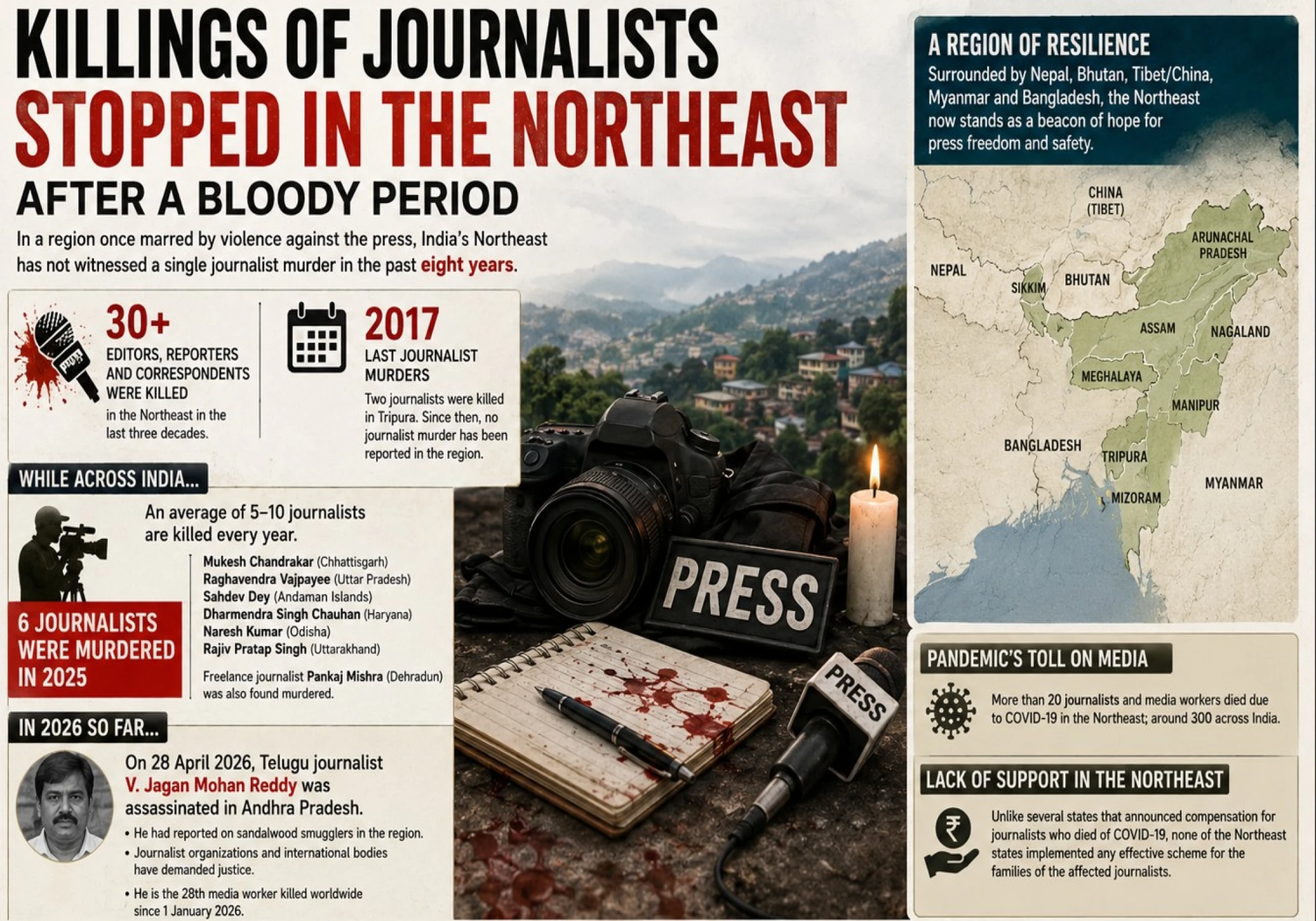
In India's northeast, once known as a troubled region, where more than 30 editors, reporters and correspondents were killed by attackers in the last three decades, there has been no case of journalist murder for the past eight years. After the last sensational killings of media professionals in the year 2017, more than four months ending in the year 2025 have passed and no such unfortunate incident has been reported during this time.
While an average of five to ten journalists lose their lives every year across the country, this region, surrounded by the borders of Nepal, Bhutan, Tibet/China, Myanmar and Bangladesh, maintains this positive situation. India, which has a population of more than one billion, recorded six murders of journalists last year. Among them are Mukesh Chandrakar of NDTV Stringer from Bastar (Chhattisgarh), Raghavendra Vajpayee of Dainik Jagran from Imalia Sultanpur (Uttar Pradesh), Sahdev Dey of Republic Andaman from Diglipur (Andaman Islands), Dharmendra Singh Chauhan of Fast News India from Gurugram (Haryana), Naresh Kumar of Times Odia from Bhubaneswar (Odisha) and Rajiv of Delhi Uttarakhand Live from Joshiyara (Uttarakhand). Pratap Singh is involved. Apart from this, the case of suspected murder of freelance journalist Pankaj Mishra from Dehradun also came to light.
India, the world's largest democracy, has lost a journalist at the hands of attackers so far this year. On 28 April 2026, Telugu journalist V. Jagan Mohan Reddy was assassinated. Jaganmohan, who was out for a morning walk in Venkatagiri Kotain area of the Chittoor district of Andhra Pradesh, was attacked by a group of miscreants armed with deadly weapons, killing him on the spot. After the murder of 40-year-old Jagan Mohan, associated with 'Andhra Jyoti' newspaper, various journalist organizations staged protests at the Tirupati Press Club.
The Indian Journalists Union (IJU) claimed that the attack came days after a report in which they had published a report on sandalwood smugglers operating in the region. The organization also demanded strict policy to ensure safety of working journalists and freedom of press. Press Emblem Campaign (PEC), a global media protection and rights organization based in Geneva, also demanded justice for Jagan Mohan. PEC President Blaise Lempen appealed to the authorities concerned to arrest the culprits quickly and ensure strict punishment under the law. Jagan Mohan became the 28th victim among media personnel killed worldwide since 1 January 2026. He is survived by his wife, two children and many well-wishers.
In contrast to this dismal national scenario, the Northeast region presents a relatively better picture. The last time two journalists—Shantanu Bhowmick and Sudeep Dutta Bhowmick—were murdered in Tripura in 2017 in this region of nearly six crore people. Earlier in 2013, three media persons—Sujit Bhattacharya, Ranjit Chaudhary, and Balram Ghosh—were killed in the same state along the Bangladesh border. The three were killed inside the office of a Bengali newspaper in Agartala.
In Assam and Manipur there were earlier cases of journalist murders when Raihanul Nayum and Dwijamani Nanao Singh were targeted by criminals. More than 25 media workers have been killed since 1987 in Assam alone.
However, the Covid-19 pandemic has taken a deep toll on the region's media world. More than 20 journalists and media workers have died due to corona infection in the Northeast, while this figure has reached around 300 in the entire country. In the Northeast, the highest number of deaths were recorded in Assam, while no journalist died of corona infection in Arunachal Pradesh, Nagaland, Mizoram, or Sikkim.
The first case came from Guwahati when, on 3 July 2020 Rantu Das, the printer and publisher of 'Asomiya Khobor', was declared dead due to complications related to Corona. After this, rural journalist Dhaneshwar Rabha from Udalguri, journalist Asim Dutta from Silchar and radio news anchor Gulab Saikia also died due to complications related to Corona during treatment in Guwahati.
Assam during the corona epidemic, two prominent media personalities—Dr. Lakshmi Nandan Bora and Homen Borgohen—also lost. Young journalist Ayushman Dutta, Jadu Chutia of Moran, Shivcharan Kalita of Chaigaon, Rubul Dihingia of Bokajan, and Humeshwar Heera of Nagaon were also included in the list of Corona victims. Assamese journalist Nilakshi Bhattacharya (55) living in New Delhi and her husband, Kalyan Baru, died of a corona infection within 24 hours. Journalist Anirban Bora also succumbed to the virus in Delhi.
In Tripura, cases of deaths of media persons due to Corona have come to light with the deaths of Jitendra Debbarma, Tanmay Chakraborty, Gautam Das and Manik Lal Das. At the same time, Manipur lost Sagolsam Hemant, Saikhom Shanti Kumar, Thotshang Shaija, and Larenjam Bijan Singh, while in Meghalaya, Sindoor Singh Siem died due to complications arising from Corona.
Although the New Delhi-based central government and some state governments have announced compensation to the families of journalists affected by Corona, none of the states in the Northeast have taken concrete steps towards implementing any such effective scheme. The Odisha government has provided an ex gratia of Rs 15 lakh to the family of each working journalist who lost their life due to a corona infection. The governments of Uttar Pradesh, Tamil Nadu, and Punjab gave compensation of Rs 10 lakh each per family. Andhra Pradesh and Chhattisgarh have given assistance of five lakh rupees each, while Bihar has announced compensation of four lakh rupees and Telangana two lakh rupees.
The Assam government had initially announced that media workers who lost their lives due to Corona would be covered under a Rs 50 lakh life insurance scheme like other frontline warriors. But later on, the government remained completely silent on the issue of providing assistance to the families of the affected journalists. Other states of the Northeast also adopted almost the same stance, as is often seen in this region.